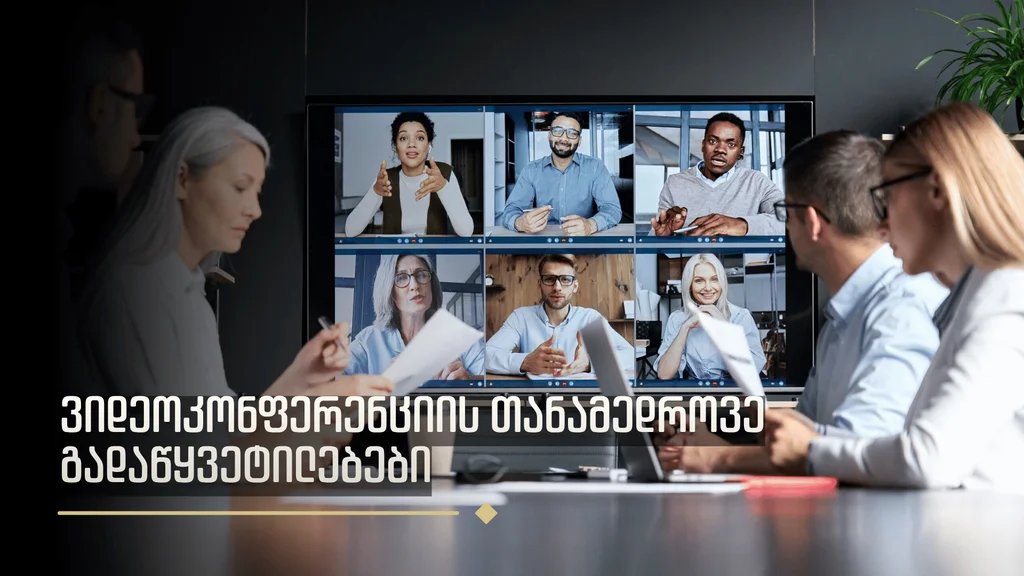
Video conferencing is an important part of the modern workspace. Meetings are no longer limited to a single office or city; companies interact daily from various locations, join international meetings, hold hybrid presentations, and collaborate with remote teams.
In these conditions, the quality of video conferencing is no longer determined solely by internet speed or a computer's camera. A modern conference space requires a correctly planned audio-video system that ensures clear sound, high-quality imagery, simple management, and seamless operation with various communication platforms. That is why when creating a modern meeting room, it is important not to select individual devices, but to plan them as a unified system.
What does a modern video conferencing system include?
A full-fledged video conferencing system is a combination of several components. Its configuration depends on the size of the space, the number of participants, the format of the meetings, and the organization's needs.
The main components of the system are:
Professional camera; Conference microphones; Speakers or audio system; Screen, LED, or projector; Video conferencing platform; DSP and audio processing; Control system; If necessary: video switcher, recording and streaming system. It is important that these components are compatible with each other. For example, using a high-quality camera matters little if the sound in the room is uneven or if the microphone does not effectively process ambient noise and echo.
Camera: The main visual component of the meeting
During a video conference, the camera is the 'eyes' of the room for remote participants. Therefore, instead of a standard laptop camera, professional PTZ or professional cameras with automatic tracking functions are often used in a professional conference space.
This is especially important for medium and large conference rooms where not all participants are at the same distance from the camera.
Modern cameras may additionally have:
Auto Framing: Automatic framing of participants; Speaker Tracking: Automatic detection of the active speaker; Preset positions: Predefined camera views; AI Tracking: Automatic recognition of participants and controlling the frame based on their movement. For example, some of AVer's professional PTZ cameras are designed for exactly such scenarios and offer Auto Tracking and other automated functions depending on the specific model.
When the camera finds the speaker itself
One of the important directions of modern video conferencing is Speaker Tracking. Imagine a conference room where ten people are sitting at a table. During the meeting, one of the participants starts speaking.
In a properly planned system, the process might develop as follows:
Participant starts speaking → Microphone detects the active speaker → System transmits information to the camera → Camera selects the appropriate view → Remote participants see the speaker.
This is especially effective in hybrid meetings, as the online participant no longer has to observe the whole room to understand who is speaking.
Often, the most attention during a video conference is paid to the camera, although in reality, high-quality audio is equally important for clear communication.
If the participant cannot hear the sound well, a high-resolution camera will not improve the meeting experience. A conference space can use:
Tabletop conference microphones; Ceiling-integrated microphones; Omnidirectional microphones; DSP audio processors; Echo Cancellation; Noise Reduction and other audio processing technologies. The type and number of microphones should be selected according to the space. For a small meeting room, one solution might be enough, while for a large boardroom, it may become necessary to use several microphones, DSPs, and zoned audio systems.
Microsoft Teams, Zoom and Google Meet
A modern video conferencing system should not depend on one specific program. Microsoft Teams, Zoom, and Google Meet are among the most common business communication platforms today, and when planning a modern meeting room, it is important that the technical infrastructure works easily with the respective platforms.
In this case, the program represents the meeting platform, and the room's hardware represents the physical infrastructure.
For example:
Teams / Zoom / Google Meet ↓ Video conferencing system
↓ Camera + Microphone + Speakers + Screen
A properly planned system allows the user to use the room's camera, microphone, speakers, and screen without unnecessary technical actions when starting a meeting.
One screen or two?
When planning a conference space, it is important to determine the number and size of screens. On one screen, it is possible to show meeting participants, a presentation, and other content.
A more comfortable solution is often the use of two screens:
Screen 1 - Remote participants
Screen 2 - Presentation or working material
This is especially convenient during hybrid meetings, when participants need to see both people and the presentation at the same time. In large conference halls, it is possible to use professional LED screens or projection systems, which are selected according to the size of the space and the number of participants.
A video conferencing solution should always be planned according to the space.
For a small meeting room, a camera, microphone, speaker, and screen in a single configuration might be sufficient.
In a medium-sized space, a PTZ camera, several microphones, an independent audio system, and a DSP might be needed. In a large conference hall, several cameras, a multi-microphone system, DSP, several screens, a video switcher, and a central control system might be used.
Therefore, the cost of a video conferencing system is not determined only by the price of a camera or a microphone. The final budget is influenced by the size of the space, the number of participants, required functions, the class of devices, and the complexity of integration.
Modern office everyday life
A hybrid meeting implies unified communication between participants in one space and those joining remotely. In such a meeting, the main task of the technology is for participants on both sides to be as equally involved as possible.
For this, it is important that:
All participants hear the sound clearly; The camera correctly shows the speaker; The presentation is easy to share; Information on the screen is easily readable; Starting and managing the meeting is simple. That is why it is necessary for the audio, video, screen, and software platform to work as a unified system.
Automation and simple management
Another important characteristic of a professional conference space is the simplicity of its management. The user should not need technical knowledge to start a meeting. If necessary, from one central control interface, it is possible to:
Start a meeting; Control the camera; Control microphones; Adjust sound volume; Turn on the screen; Share content; Select various scenarios. In more complex spaces, these functions can also be integrated with a centralized control system.
Why is pre-planning important?
It is desirable to start planning the video conferencing system at the stage of the space's renovation and interior design. The camera's position determines the angle of view. The placement of microphones affects sound quality. The screen's location and size affect participant comfort. Pre-planning the cabling allows the technology to be integrated into the interior as cleanly and unobtrusively as possible. Proper design also reduces the need for subsequent changes and additional installation work.
If you are planning to arrange a meeting room or update an existing conference space, Fresnel will help you with planning the audio-video system and selecting & integrating the appropriate technologies.