Stage Sound
Extron NetPA U 2008 FX — Eight Channels That Do Not All Need the Same Job
A review of Extron NetPA U 2008 FX: eight 200-watt channels, 4Ω/8Ω and 70V/100V modes, power sharing within channel pairs, Dante, DSP and PoE limitations.
In a restaurant, music has to suit several spaces. The dining area has ceiling speakers, the bar has more powerful wall-mounted speakers, and a separate line runs to the terrace. Each zone needs a different load, sound level and sometimes different music. In a project like this, wattage alone no longer determines the amplifier choice.
Extron NetPA U 2008 FX is interesting for precisely these systems: eight amplifier channels, each nominally rated at 200 watts, Dante network audio and onboard DSP in one enclosure. Its principal advantage is the ability to define each channel's role in software.
*This review is based on official manufacturer documentation. No listening tests or independent measurements have been conducted; practical assessments are an analysis of published information.*
Each output on this model can independently be set to 4Ω, 8Ω, 70V or 100V. One amplifier can therefore drive low-impedance speakers and transformer-equipped speaker lines simultaneously. In a multi-zone project, this reduces the need for different amplifier types and leaves more flexibility for system expansion.
For example, the terrace's 100V line and the bar's 4Ω load can be assigned to different channels. This flexibility does not remove the rules for connecting speakers: the mode must match the actual load. On a low-impedance channel, total speaker impedance matters; on a 100V line, the sum of the selected transformer tap powers matters. The software setting must match the real cables and speakers.
Power allocation is even more interesting. Adjacent odd- and even-numbered channels share a resource: within a pair of 200-watt channels, one channel can receive up to 400 watts when the other channel is not loaded. This is convenient when one zone needs more power and the other is unused.
The critical word here is pair. The device's total power is not a common pool that can be assigned freely to any output. Increasing one of the eight channels carries a limitation tied to its adjacent partner. Channel allocation should therefore be planned during design. A list based only on speaker counts cannot make full use of this device's capabilities.
The 200-watt figure also comes with measurement conditions. Extron specifies 200 watts per channel with all channels driven, at 1 kHz and 0.2% THD. The 400-watt rating applies when one channel in a pair is driven. This is useful precision, but it cannot replace independent testing under sustained load across the full frequency range.
Dante makes the amplifier part of a wider system. It can receive eight network audio channels and transmit eight, with AES67 support as well. The audio format is 24-bit, 48 kHz. The practical benefit is especially clear when the source and amplifier are in different parts of a building and audio distribution is already network-based.
Network connectivity adds responsibility too. Lost sound may result from either the audio route or the network configuration. A properly delivered project should therefore include clear device names, documented channel assignments and configuration backups accessible to service personnel. Dante simplifies cable organization but does not reduce the need for commissioning.
The onboard DSP is one of this model's most valuable features. A 16×20 matrix provides flexible signal distribution, with filters, dynamics processing, delay and level controls. However, twenty outputs does not mean twenty amplified speaker channels: the device has eight of those. The remaining resources relate to line-level and network audio outputs.
This lets us assign different sources, equalization and level limits to different zones. Eight channels do not, by themselves, create eight independent music players. Different music also requires suitable sources. With stereo distribution, each zone takes two amplifier channels — a factor that changes the channel budget quite quickly.
For me, the main value of DSP is organizing everyday operation. A correctly commissioned zone lets users adjust the volume within a safe and useful range. A poorly configured zone may sound tiring even with a powerful amplifier. This is particularly important in a restaurant, where intelligible conversation and pleasant background music must be maintained together.
PoE support is another feature that needs careful reading. Auxiliary power received through the LAN/AT 1 port keeps the DSP, Dante, line-level audio and control section operating when mains power is lost. This preserves certain system functions. The speaker power stage still needs mains power; connecting PoE does not provide backup power for the entire amplifier.
Extron specifies an InstaWake wake-up time of less than 50 milliseconds. This describes returning from standby. According to the installation guide, initial startup can take up to a minute, followed by the time needed to synchronize with the Dante network. Powering up and waking an already running device from standby are different processes.
The physical format is attractive: eight channels fit into a 1U enclosure. However, this model uses fan cooling, with airflow from front to rear. The manufacturer requires unobstructed ventilation openings. In a technical room, this is a normal design consideration; if installed in a quiet meeting space, the actual fan noise should also be heard. Without independent acoustic measurements, I would not draw a conclusion about how quiet it is.
Dependence on software configuration also matters for maintenance. The manual states that settings are managed through DSP Configurator Pro or SIS commands. The customer should not receive only an operational system: the configuration file, zone diagram and understandable control interface are also part of the final result.
In my assessment, NetPA U 2008 FX is most convincing for a restaurant, hotel, educational building or commercial space where several independent zones and different speaker types must be combined in one system. For a simple two-zone site, its resources may be excessive. In a multi-zone project, flexible outputs, network audio and local DSP offer real design advantages.
The value of this Extron lies in using its channels intelligently. Before purchasing, I would establish the load of each zone, how power is shared within pairs and how everything is controlled day to day. Good answers to these questions turn eight channels into a well-organized audio system.
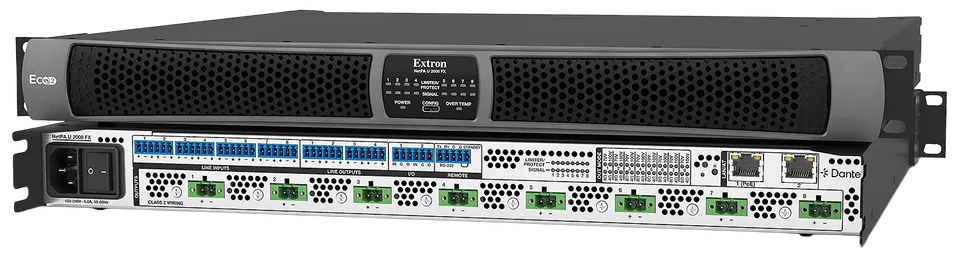
Photo: Extron.
Sources
Project Context
Ready to Apply This in Your Space?
A final engineering solution requires an assessment of your space, intended use and existing infrastructure.
Request a Consultation